A Wire Monkey Labs product
Calculations at the desk. Drawings from the field.
Conductor sizing, panel schedules, motor circuits, transformer and fault current, and one-line risers you can draw standing in front of the gear.
Built for electricians and design engineers who need the answer and the article it came from. Everything runs on the device. One subscription, every feature.
$5.99/month or $59.99/year · every feature, no tiers · on Google Play now, App Store soonThe tools
Five things a designer reaches for daily, and a riser builder for the room itself.
Everything on device. No account, no sign-in, no signal required.
Circuit
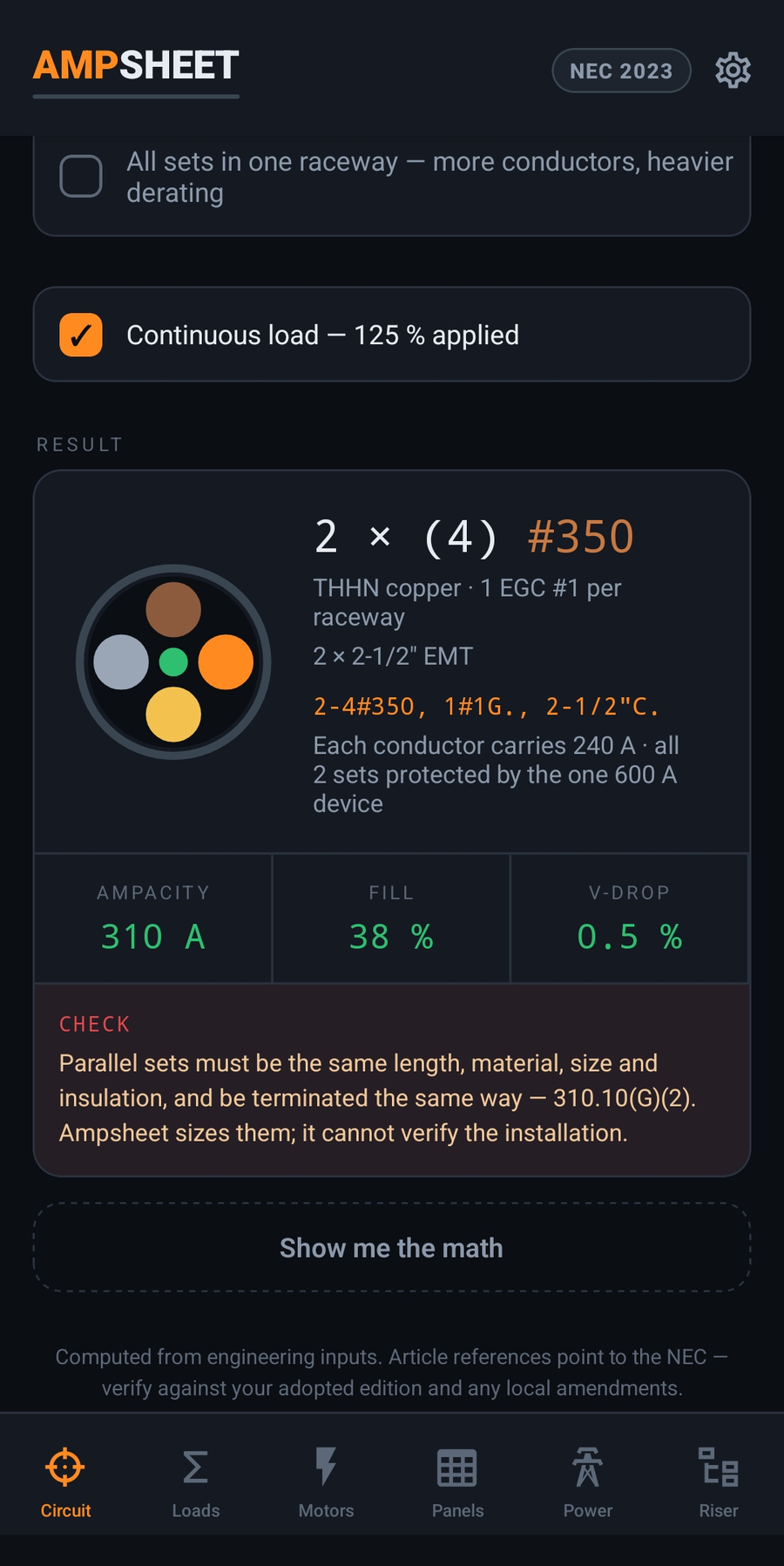
Conductor sizing against the two-step derate and termination rule, voltage drop with real impedance at power factor, raceway fill, and parallel sets. Shows the derivation, not just the answer.
Loads
FLA, amps, VA or kW at any voltage and phase, with a running tally you build straight off a mechanical schedule. Flags continuous loads and sizes the breaker at 125 %.
Motors
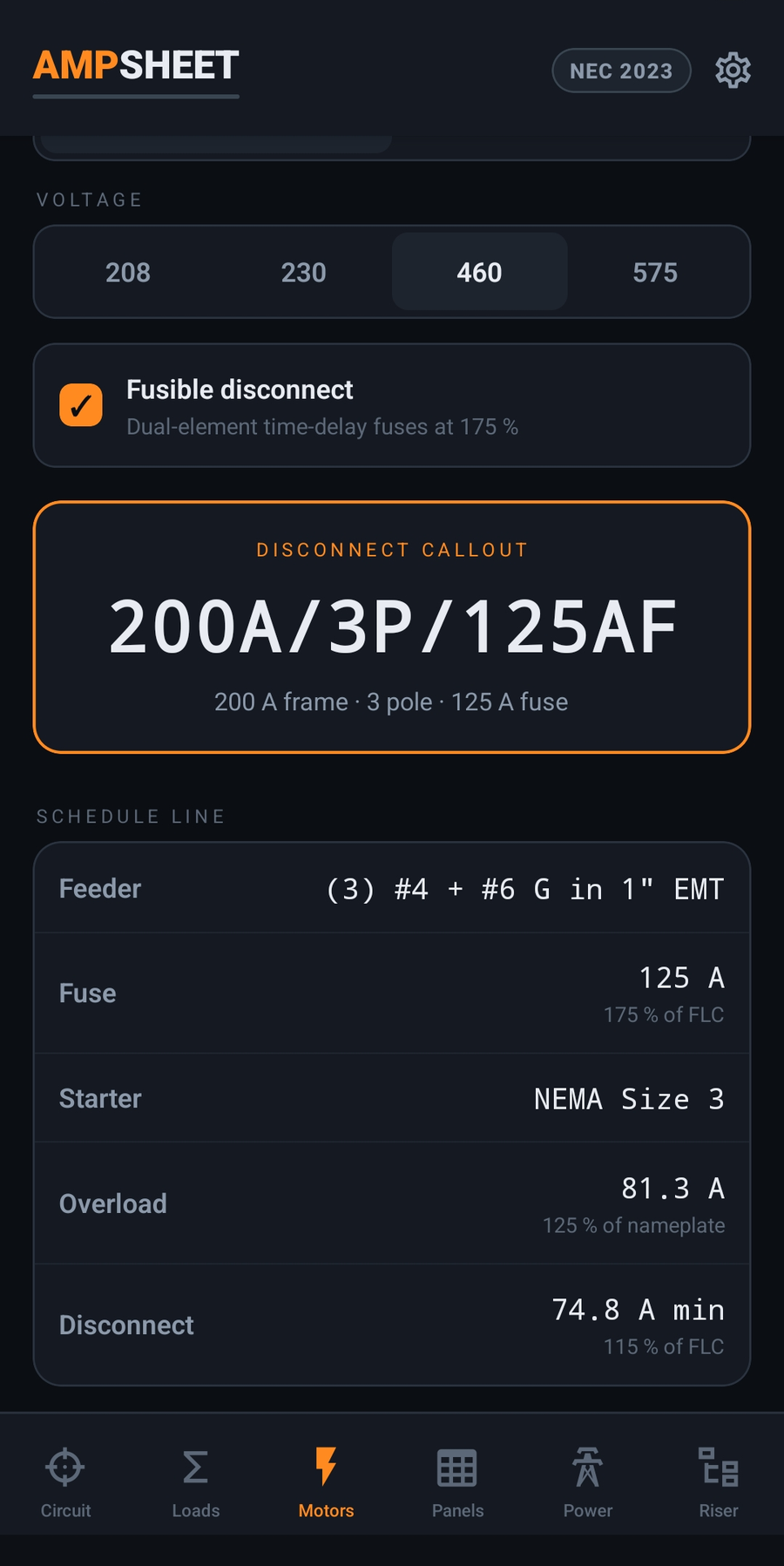
Table full-load current, branch protection, overload, disconnect and NEMA starter. Keeps table FLC and nameplate FLA in their separate jobs, because they are not interchangeable.
Panels
Schedules from a six-circuit load center to a four-section switchboard. Phase rotation across sections, load classification rollup, noncoincident handling, and a design review.
Power
Transformer sizing and primary protection, with available fault current from a complex impedance network rather than a lookup table.
Riser
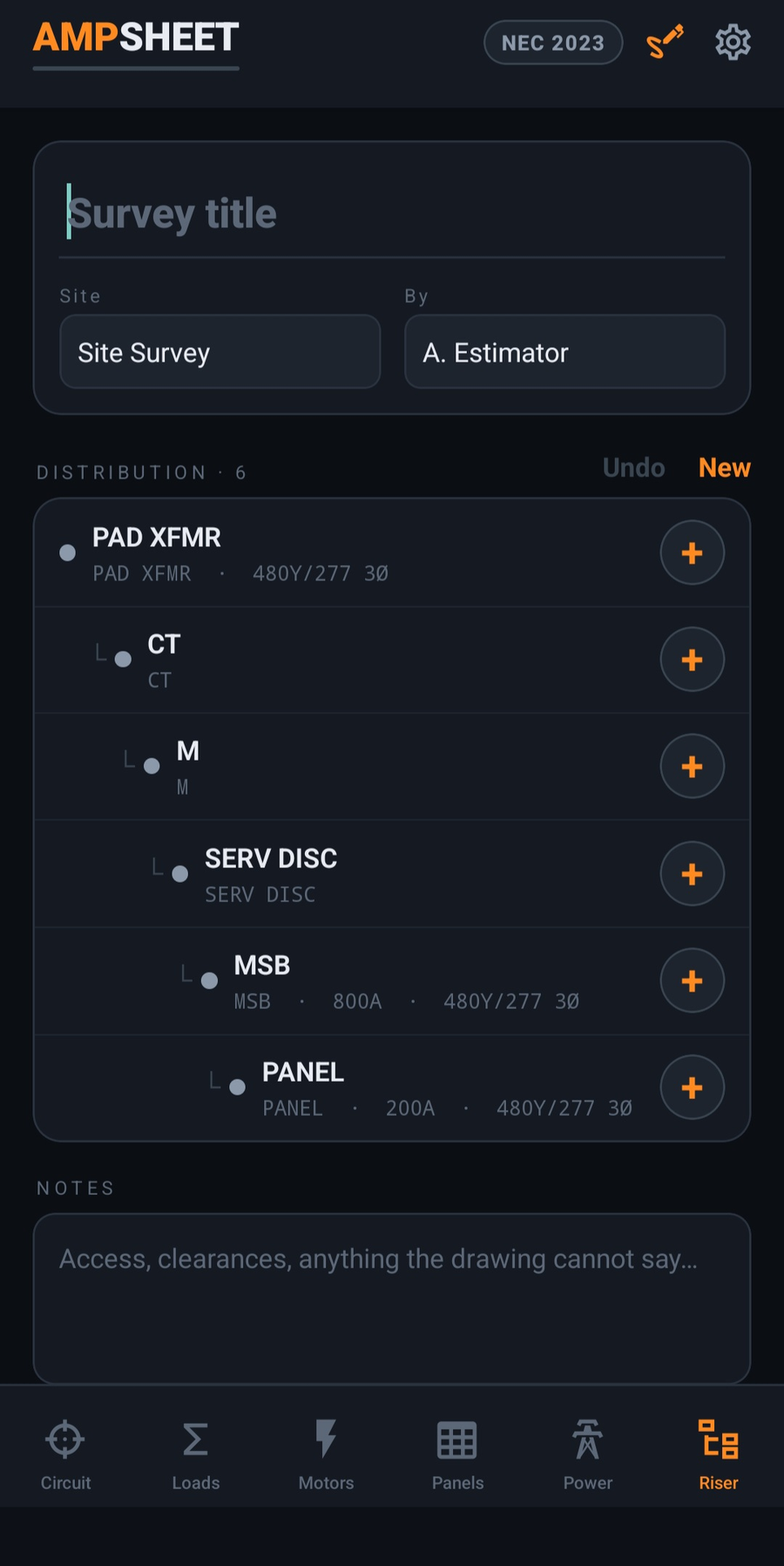
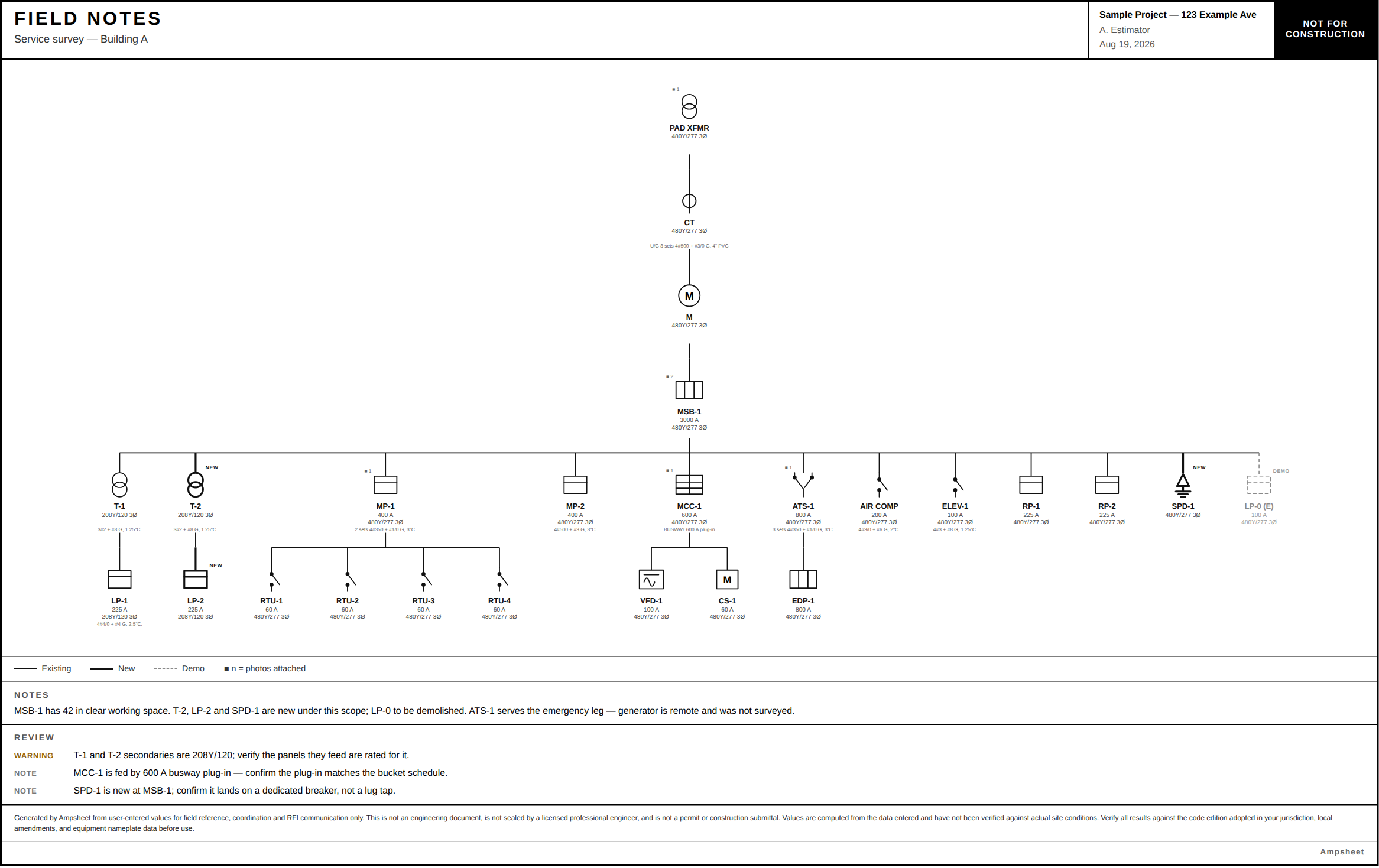
Walk a service and record it as you go. Pick the utility source, then work downstream — the app draws the one-line. A multi-story building is drawn the other way up, as a building riser: floors stacked the way the building stacks them, service at the bottom, feeders climbing. Photos, existing / new / demo status, and a printable sheet.
The kind of thing it catches. A 25 kW charger at 480 V three-phase draws 30.1 A. That points at a 35 A breaker, and 35 A is wrong — EV supply equipment is a continuous load, so it sizes against 125 % of the draw. The answer is 40 A. Ampsheet says so, and cites the article that says so.
Output
What comes off the phone.
Exports are for field reference, coordination and RFIs. Every sheet says so on its face.
Open the full sheet (PDF)
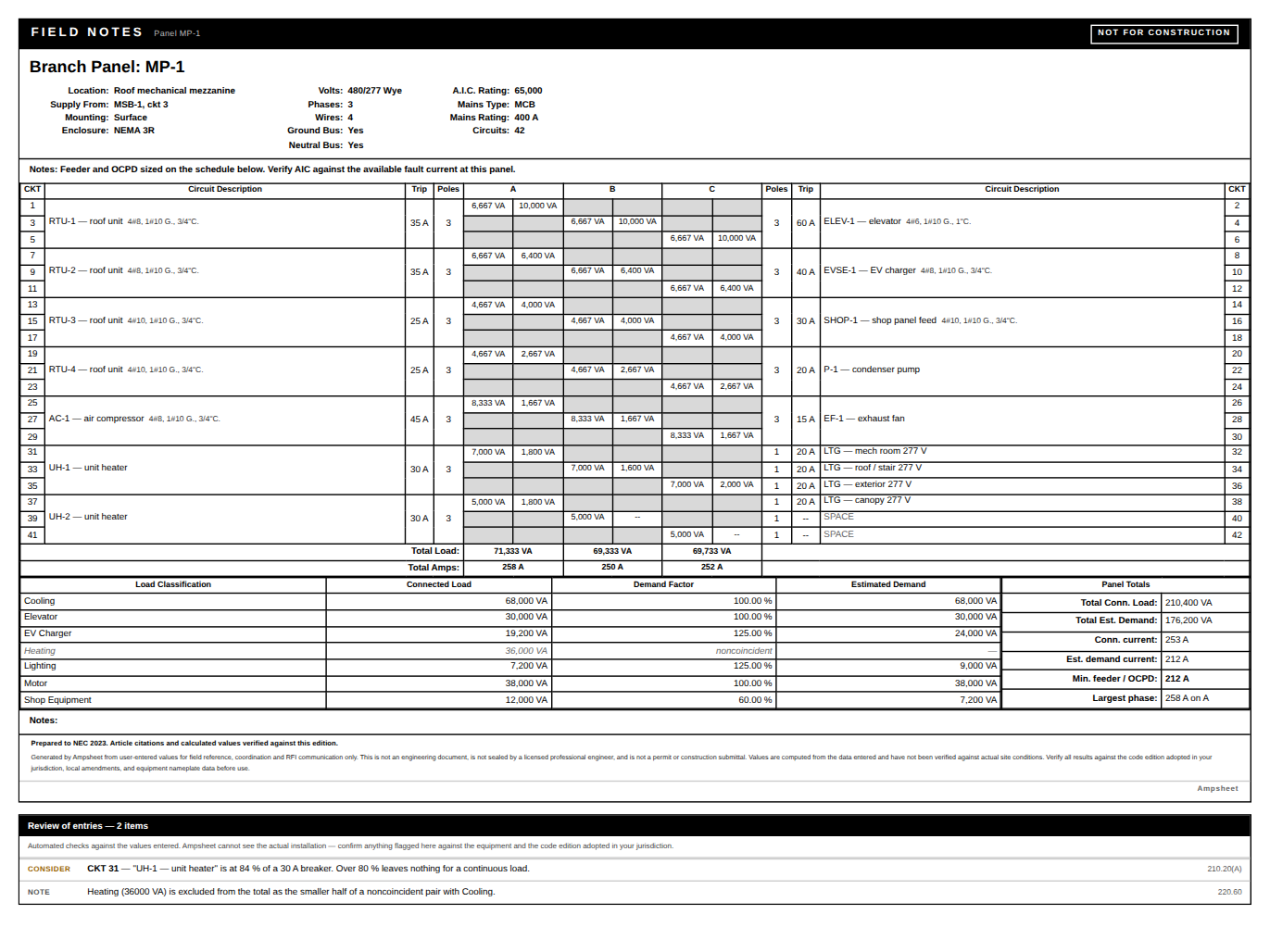
Open the full sheet (PDF)
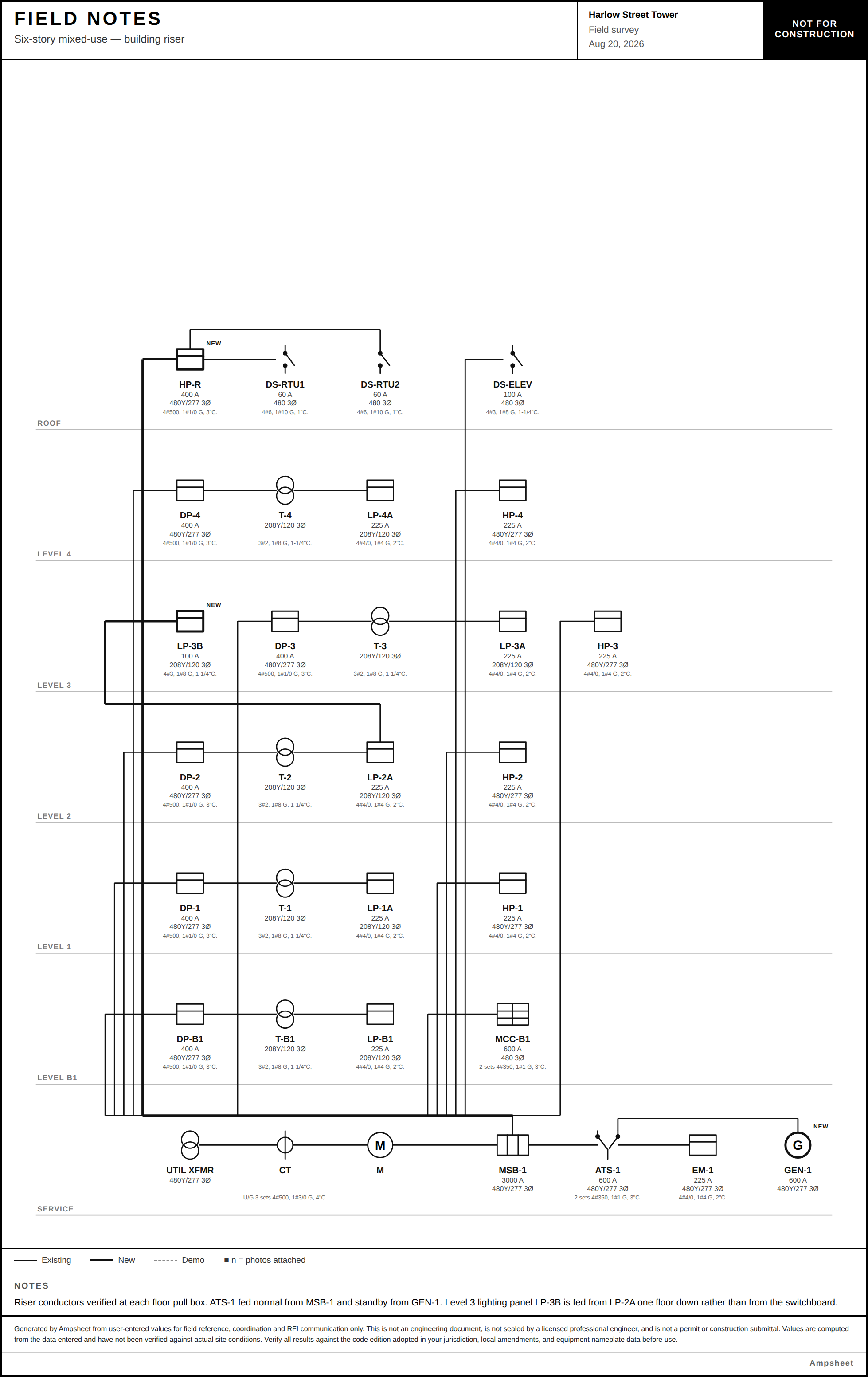
Each gap between columns is a shaft, and it is only as wide as the feeders actually running in it — the one carrying six risers off MSB-1 is wide, the ones carrying none are not. ATS-1 shows both of its supplies: normal from the switchboard into one pole, standby from GEN-1 into the other. The generator has no conductor running into it, because nothing in the building feeds a generator.
Open the full sheet (PDF)
Mark-up
Then redline it, on the phone, and send the RFI.
Open any sheet the app made, draw on it, export it again. Boxes, circles, arrows, freehand and text, in four colors, with undo. The marks go into the PDF as vectors — they stay sharp at any zoom because nothing is ever rasterized.
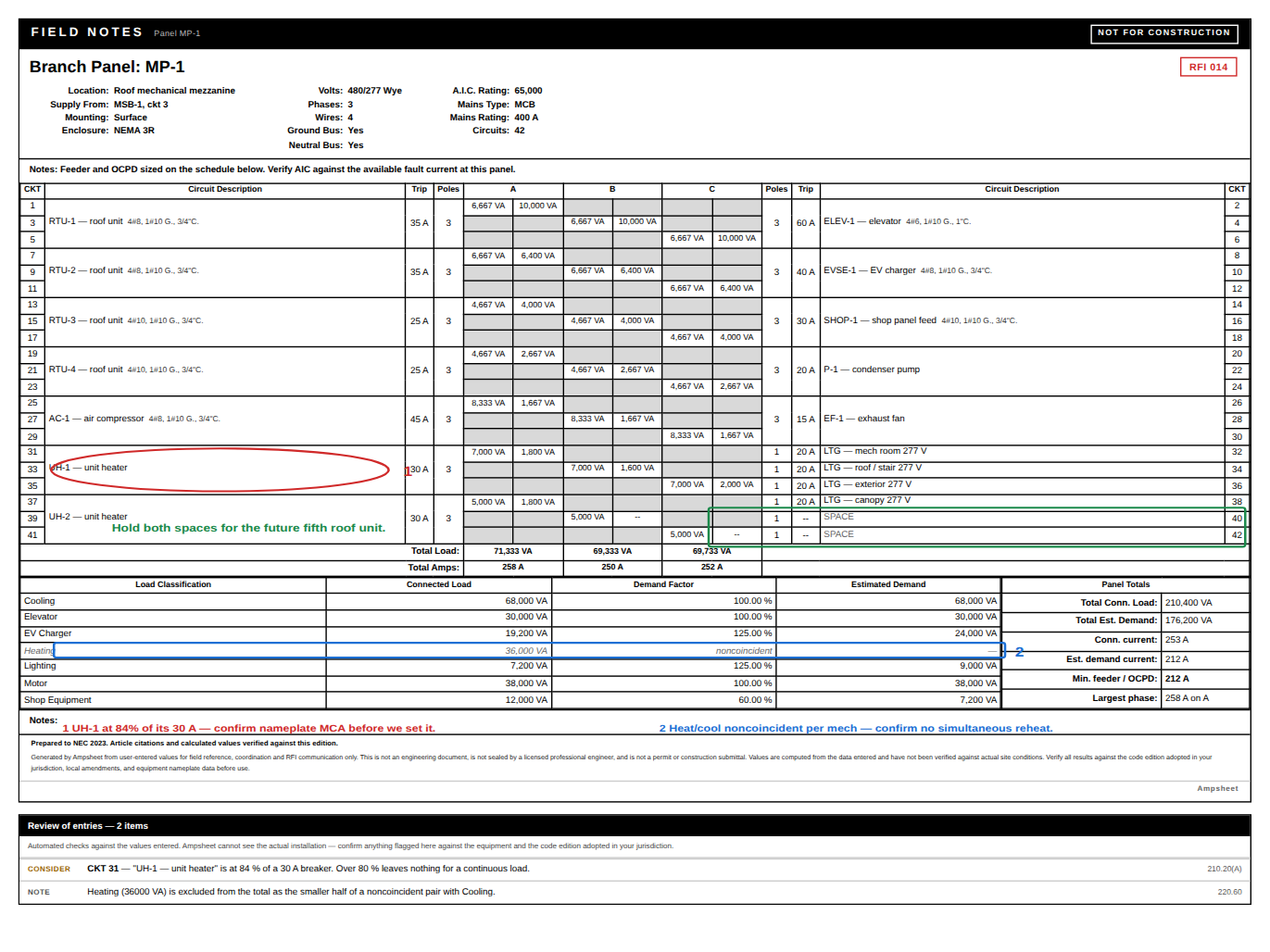
Open the marked-up sheet (PDF)
How it is built
Three code editions, read rather than assumed.
Ampsheet supports NEC 2020, 2023 and 2026, and translates article numbers between them — a rule that moved between editions is shown under the number your jurisdiction actually uses. Where we have not confirmed a citation for the edition you selected, the app marks it instead of guessing.
Adoption varies by jurisdiction. Ampsheet supports these editions; it does not know which one your inspector enforces, and it says so.
The six commitments behind that — runs on your device, works with no signal, shows its work, marked for what it is, bought once, and says what it did not check — hold across everything we publish, and are set out in full on the company page.
Before you rely on it
What Ampsheet is not.
Ampsheet is a reference and calculation tool. It is not an engineering service, and nothing it produces is a sealed or approved document. You are responsible for verifying every result against the code edition adopted in your jurisdiction, any local amendments, and the actual nameplate data of the equipment involved.